
Kapwork Grow figures from the federal directory publication of October 29, 2026.
In brief. Federal agencies obligated about $793 billion on contracts in fiscal 2025 (GAO), and $304 billion of it in the year's last quarter (GovSpend). Every one of those contracts goes to a prime, and on construction the prime hires subs to do much of the work. Above $2 million, a large construction prime usually has to file a plan for subcontracting with small businesses before it signs. Kapwork Grow lists 3,008 new federal construction and telecom contracts of $1 million or more, signed in the last 12 months: who won each one, who bought it, the work, the place and the dates, free. Free invoice certification then lets a sub fund that work from the invoices it sends the prime.
An award record is the most solid early signal a sub gets. It is a signed contract, not a press release. The agency has committed the money, the prime has a start date, and someone has to pour the concrete, pull the cable and wire the building.
What the record doesn't show is who the prime has already lined up. This article covers what the records show, what work they send to subs, how federal money reaches your invoice, and how to have funding ready before your first pay application.
What a federal award record tells you
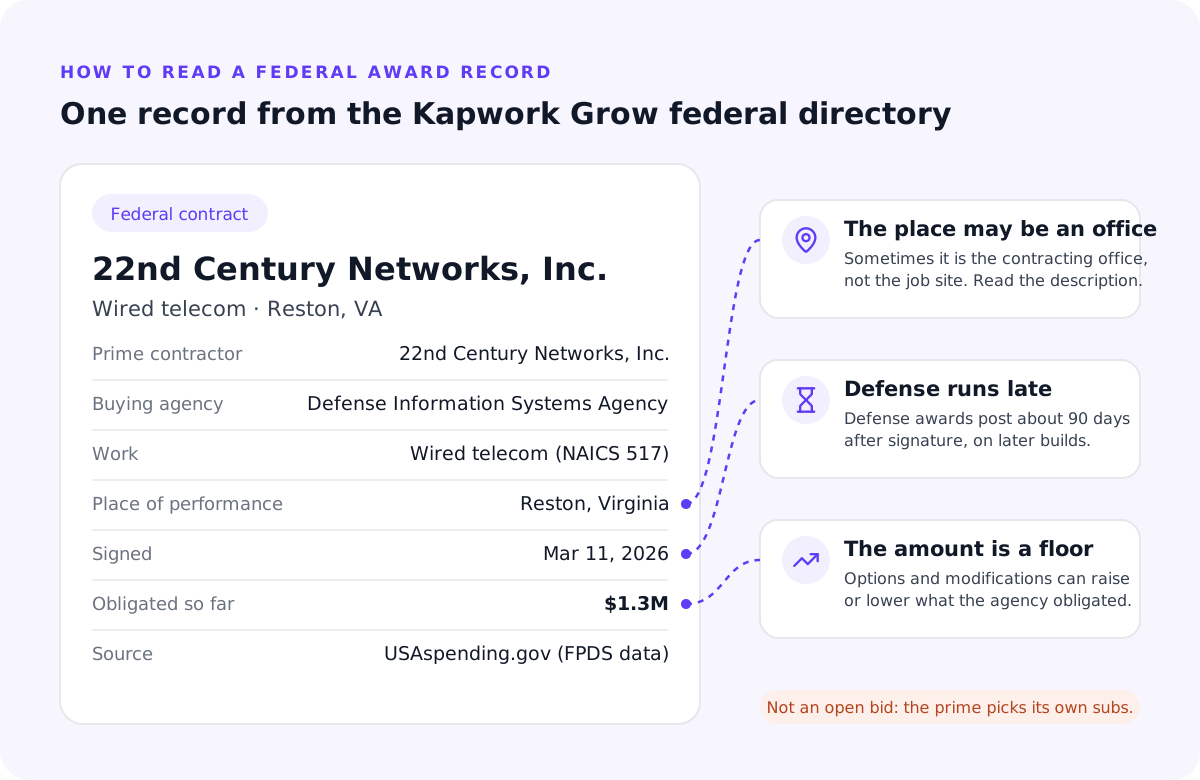
Federal contract awards are reported to the Federal Procurement Data System (FPDS), and USAspending.gov publishes them. Each record names the prime contractor that won the work, the agency and buying office, the type of work by industry code, the place of performance, the date it was signed and the amount obligated so far.
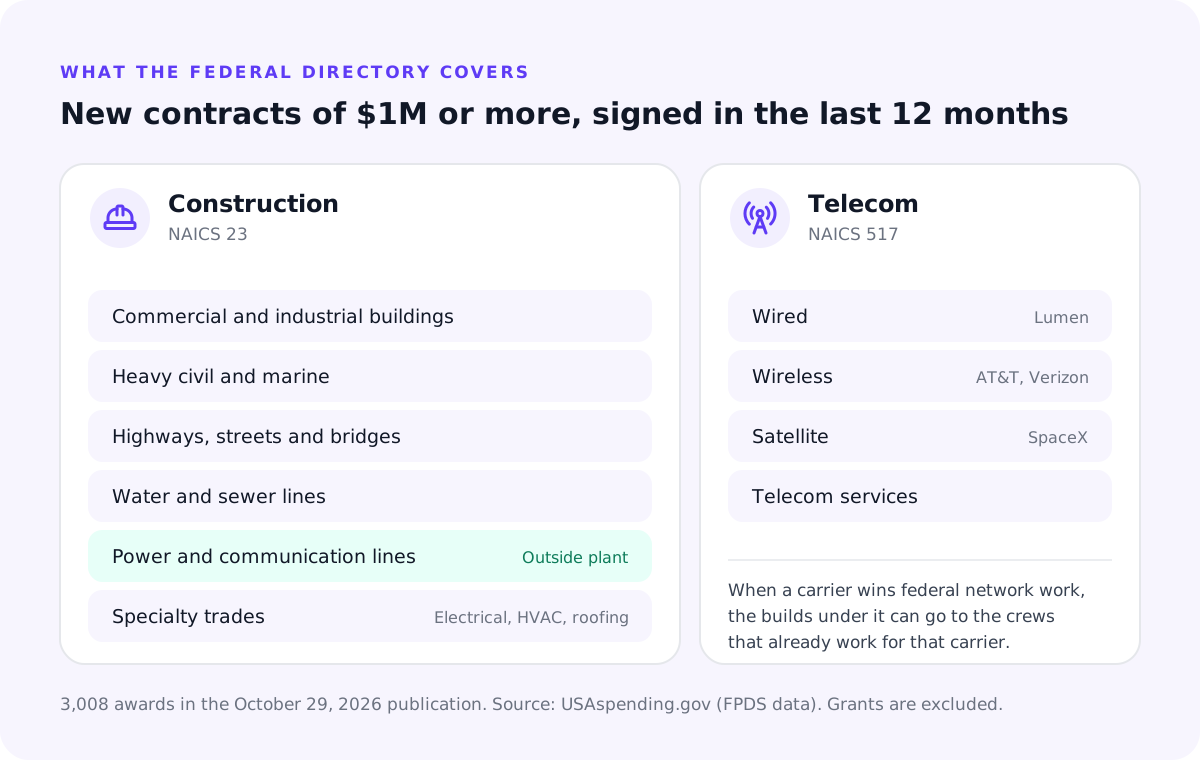
Kapwork Grow takes the slice a construction or telecom sub cares about. That means contracts, purchase orders and orders (not grants) for construction (NAICS 23) or telecom (NAICS 517), with $1 million or more obligated, signed in the last 12 months and performed in the United States. In the October 29 publication that is 3,008 awards, signed between October 22, 2025 and October 21, 2026. The directory rebuilds every week, and grants stay out, so no BEAD dollar is counted twice.
Three things to know before you read one:
- The amount is a floor. It is what the agency has obligated so far. Options and modifications can raise or lower it.
- The place may be an office. It is the place of performance the contracting officer entered. For some awards that is the contracting office rather than the job site, so read the description.
- Defense runs late. Defense contracts appear about 90 days after signature, so the newest Defense awards arrive on later builds.
And one thing the record can't tell you. An award is not an open bid. The prime decides its own subcontracts, some of them are on paper by the time the award posts, and no public record lists the subs a prime has hired. Treat a listing as a research signal, and confirm the prime's needs before you mobilize.
What work federal contracts send to subs
Most of the directory is construction. Commercial and industrial buildings, heavy civil and marine work, highways and bridges, water and sewer lines, and the specialty trades under them, from electrical and HVAC to roofing and elevators. Veterans Affairs medical work, projects on Army, Navy and Air Force bases, federal buildings along the southern border and roads in national parks all show up.
For telecom crews, two groups matter most.
Power and communication lines is the construction code for outside-plant work: duct banks, conduit, fiber and copper across a base or a campus. Contractors such as Kiewit, Koontz Electric and Sandhills Utility Services hold awards there.
Telecom covers the carriers' own federal contracts: wired service from Lumen's government unit, wireless from AT&T and Verizon, satellite capacity from SpaceX. When a carrier wins federal network work, the fiber builds, tower work and site installs under it can go to the same crews that already build for that carrier.
The customers are familiar. Lumen and AT&T are names telecom subs already bill. On the construction side, the primes are general contractors like Whiting-Turner, Hensel Phelps and Clark, who run federal jobs with sub lists of their own.
How federal money reaches a sub's invoice
On a federal job you don't invoice the government. You invoice the prime, and the prime invoices the agency. That makes the chain longer than it looks.
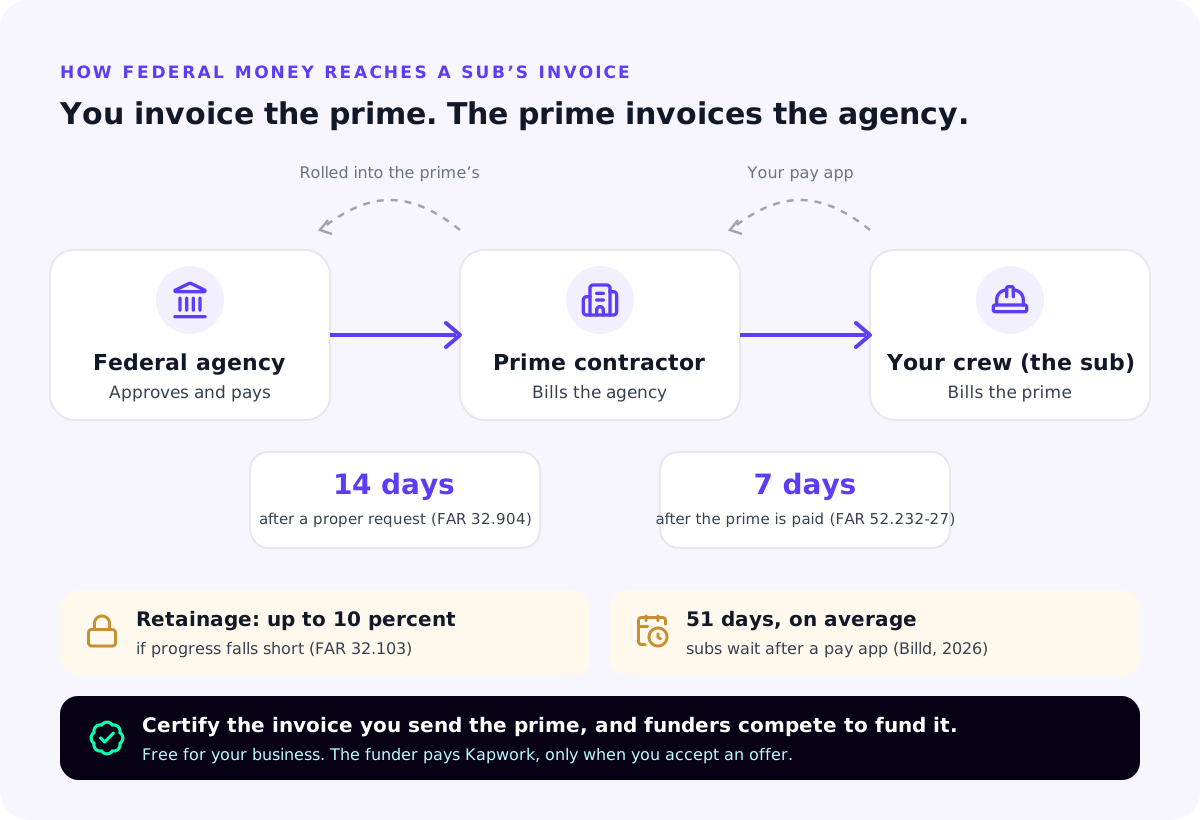
The agency pays a construction prime's progress payments 14 days after it receives a proper payment request (FAR 32.904). The prime then has 7 days from its own payment to pay you for satisfactory work (FAR 52.232-27). That rule lives in your subcontract: a late prime owes you interest, and a dispute runs through your contract with the prime, not through the agency. If progress falls short, the agency can hold back up to 10 percent of a progress payment until it catches up (FAR 32.103), and many primes hold retainage from their subs under the subcontract. Add the days it takes your pay application to roll into the prime's, and subs across construction wait an average of 51 days after submitting a pay application (Billd, 2026 National Subcontractor Market Report).
There is protection at the end of the chain. Federal construction contracts over $150,000 require the prime to post a payment bond under the Miller Act, so a sub who goes unpaid can claim against it. That is a remedy, not cash on Friday. Mobilization, payroll and materials still sit on the sub while the chain runs.
One detail matters for funding. Your invoice is owed by the prime, so a funder looks at the prime's payment record the way it would at any large customer. Kapwork has certified more than $700 million in receivables, most of it from telecom and data center providers, so this gap is the one we see every day.
How to find federal awards in Kapwork Grow
The federal directory is free, and the public pages need no login. Here is how a sub uses it:
- Type a trade, an agency, a company or a place into the search box: "power and communication lines Texas", "Veterans Affairs" or a prime's name. Federal awards come back in the same list as BEAD awards and data center builds.
- Read the result line: the prime, the work, the place, the amount and the date it was signed.
- Open the award page. Every fact shows its source and date, so the page can go straight into your bid file.
- Filter by state to see everything in your territory.
- Set a free alert for your states: a Monday email when awards move, or every morning if you choose.
Kapwork Grow is free because Kapwork earns its fee from funders, when a business accepts a funding offer, and never from the business.
How to get on a prime's sub list
The award is the earliest public signal you get, and on large construction jobs the prime's subcontracting plan was written before it signed. Four things to do the week an award shows up in your state:
- Find the prime's supplier process. The award page names the prime. SBA keeps a directory of primes with subcontracting plans, and SubNet posts subcontracting notices from primes.
- Get your federal basics in place. A prime reporting its subcontracts will usually ask for your Unique Entity ID, and registering in SAM.gov is free.
- Get your prequalification package current: insurance certificates, bonding capacity, safety record, small business certifications and references from similar federal work.
- Line up funding before the first pay application. A new bank line takes 7 to 11 weeks to open. Certifying the invoices you already send takes one 20-minute setup, and the offers are on the table when the first pay app goes in.
What a certified invoice is
A certified invoice is one whose existence, amount, approval status and payment terms Kapwork has certified within your customer's own system of record, usually a vendor portal like Ariba or Coupa. It has nothing to do with the certified payroll federal construction subs also file. You sign in to the portal yourself, inside Kapwork, connect it once, and the certificate keeps itself current from what the portal already shows. Funders in the Kapwork network then bid on it, and a certified invoice draws more offers and better rates than one a funder has to verify by phone. Kapwork never contacts your customer. The full mechanics are in our BEAD article.
Where to start
Browse new federal construction and telecom awards at kapwork.com/grow/directory/federal, free, and set an alert for your states. To certify the invoices you already send, start here. Or take 20 minutes with Kyle Mason, Kapwork's Head of Risk & Capital Solutions. Funding questions, no pitch. Free for your business; the funder pays us, only when you accept an offer.
Federal contract questions
What is FPDS? The Federal Procurement Data System, the government's record of contract awards. USAspending.gov publishes it, and Kapwork Grow reads it from there every week.
Is a federal contract award an open bid? No. It records work already awarded to a prime, and the prime decides its own subcontracts. Open federal solicitations are posted on SAM.gov.
How do I find subcontracting opportunities on federal contracts? Start from new awards in your trade and states, then go to the prime: SBA's directory of primes with subcontracting plans, SubNet, and the prime's own supplier portal.
When does a prime need a subcontracting plan? Since October 1, 2025, a large prime needs one on contracts above $900,000, or $2 million for construction, when there is work to subcontract (FAR 19.702, thresholds). Small business primes don't.
How fast does a prime have to pay a subcontractor on federal construction? Within 7 days of its own payment, for satisfactory work (FAR 52.232-27). The agency pays progress payments 14 days after a proper request, and it can hold back up to 10 percent when progress falls short.
What protects a sub that goes unpaid? The Miller Act. Federal construction contracts over $150,000 require a payment bond, and an unpaid sub can claim against it.
Does Kapwork Grow list every federal contract? No. It lists new construction and telecom contracts of $1 million or more, signed in the last 12 months and performed in the US, from USAspending.gov. Defense awards appear about 90 days after signature.
Is Kapwork Grow free? Yes. The public pages need no login, and a free account adds alerts for your states. Kapwork earns a fee from the funder when a business accepts a funding offer, never from the business.
What is a certified invoice? An invoice whose existence, amount, approval status and payment terms Kapwork has certified within your customer's own system of record. It has nothing to do with certified payroll, and it doesn't guarantee your customer will pay.
About the author. Mauricio Vergara is co-founder and CEO of Kapwork. Before Kapwork he led teams at Google, where he watched third-party developers struggle with cash flow, and before that he ran a small business that waited months on its own invoices. Kapwork was founded with Pete Thomas, who helped build C2FO, the working capital platform with half a trillion dollars in receivables flowing through it.
About Kapwork. Kapwork is an AI-native platform helping small businesses find growth opportunities, certify receivables and get matched with capital providers. The company has certified $700 million-plus in receivables, most of that coming from telecom and data center providers. Backed by SaaSholic, Kapwork is also a member of NVIDIA's Inception, a program supporting innovative AI startups. Learn more at kapwork.com.
Sources
- Kapwork Grow, federal contract awards and FAQ and methodology, publication of Oct 29, 2026
- GAO, government-wide contracting in fiscal 2025
- GovSpend, federal Q4 contract awards
- Billd, 2026 National Subcontractor Market Report
- Acquisition.gov, threshold changes of October 1, 2025
- SBA, primes with subcontracting plans and SubNet