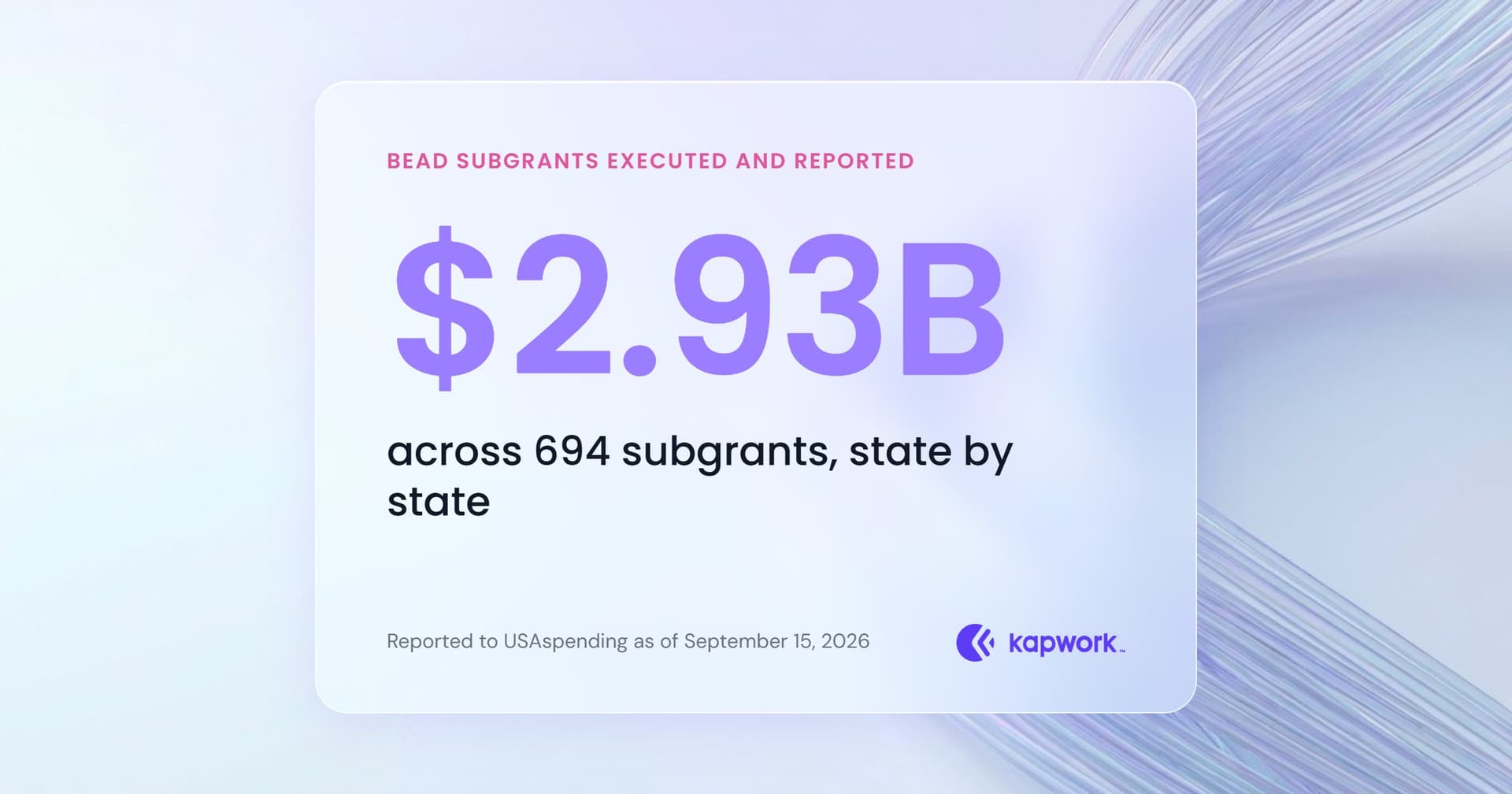
Ledger figures as of September 15, 2026.
In brief. The BEAD program is $42.45 billion, and NTIA has approved every state's final proposal as of August 26, 2026. BEAD pays subgrantees by reimbursement, after the work is done, and subcontractors are paid by those subgrantees on the subgrantee's terms. Mobilization costs on a BEAD subcontract land weeks before the first payment. Kapwork's free BEAD tracker shows who holds the awards in each state, and free invoice certification (nothing to do with certified payroll) lets a sub fund mobilization from the invoices it already sends.
Every state's BEAD final proposal is approved, and the subgrantees that won the money are signing construction contracts. As of September 15, 2026, states had executed and reported $2.93 billion in BEAD subgrants to USAspending, across 694 subgrants. For a BEAD subcontractor, each of those subgrants becomes subcontract work, and each subcontract becomes a mobilization bill weeks before it becomes a paid invoice.
Who holds the BEAD awards in each state
BEAD awards are held by state-selected subgrantees, mostly internet providers, electric co-ops and utilities, and Kapwork's free BEAD awards tracker lists every reported holder, state by state, as states announce them. As of September 15, 2026, the tracker holds $11.46 billion in reported BEAD awards. For each state it shows who holds the award, the subgrant beneath it, where the award sits from announced to agreement signed, and that state's cash rules.
One thing it can't show is the construction prime. States don't report who the subgrantee hired to build, so no public source has it. What the tracker tells you is which subgrantees hold money in your counties and when their awards reached agreement signed, which is about when their prequalified vendor lists start filling. Those lists form six to twelve months before crews roll. The award is the earliest signal you get, and most vendor lists close before an RFP exists.
The ten states with the most BEAD subgrant dollars executed and reported to USAspending (ALN 11.035), as of September 15, 2026. Allocation is NTIA's June 2023 figure. Subgrants are counted by place of performance.
| State | NTIA allocation | Executed subgrants on USAspending | Tracker |
|---|---|---|---|
| New York | $664.6 million | $444.9 million, 69 subgrants | New York BEAD awards |
| Wisconsin | $1.06 billion | $414.1 million, 102 subgrants | Wisconsin BEAD awards |
| Illinois | $1.04 billion | $320.2 million, 51 subgrants | Illinois BEAD awards |
| Michigan | $1.56 billion | $318.5 million, 24 subgrants | Michigan BEAD awards |
| Missouri | $1.74 billion | $240.1 million, 21 subgrants | Missouri BEAD awards |
| Arkansas | $1.02 billion | $191.6 million, 7 subgrants | Arkansas BEAD awards |
| Hawaii | $149.5 million | $144.5 million, 1 subgrant | Hawaii BEAD awards |
| Wyoming | $347.9 million | $122.8 million, 26 subgrants | Wyoming BEAD awards |
| Nebraska | $405.3 million | $117.7 million, 32 subgrants | Nebraska BEAD awards |
| Georgia | $1.31 billion | $103.3 million, 11 subgrants | Georgia BEAD awards |
Texas, the largest allocation at $3.31 billion, has $56.5 million across 98 subgrants on the ledger so far. California has $56.8 million across 70. The reporting lag explained below is part of why.
How a BEAD subcontractor gets paid
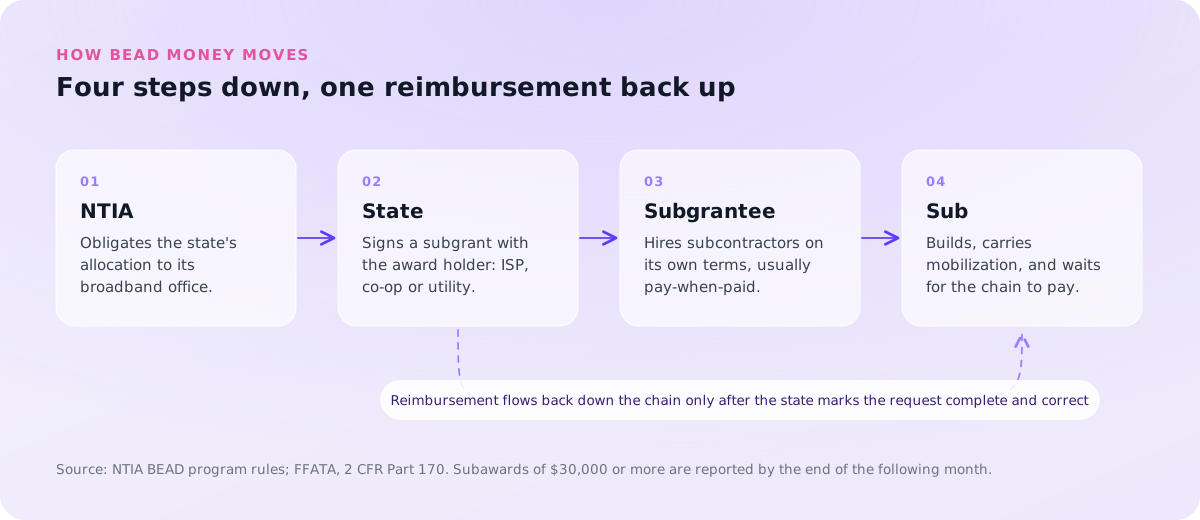
A BEAD subcontractor is paid by the subgrantee that holds the award, on the subgrantee's terms, after the subgrantee has itself been reimbursed by the state. The money moves in four steps:
- NTIA obligates the state's allocation to its broadband office.
- The state signs a subgrant agreement with the subgrantee that won the award: an internet provider, a co-op, or a utility.
- The subgrantee hires subcontractors under ordinary construction contracts and pays them on its own terms, usually pay-when-paid.
- The subgrantee builds, files a reimbursement request with the state, and is paid after the state marks the request complete and correct.
NTIA calls the award holder a subrecipient and the builder a contractor. In the field they're the subgrantee and the sub. The subrecipient carries the grant's federal compliance terms; the contractor sells construction services under a commercial contract, and NTIA's Subrecipient vs. Subcontractor 101 has the full distinction. Most fiber crews sit in the second group. The distinction matters for paperwork, and it matters more for cash. The sub gets paid by the subgrantee, and the subgrantee gets paid by the state, after the work is done, after the request is filed with whatever documentation that state asks for, and after someone in the state office marks the request complete and correct.
Federal law (FFATA, 2 CFR Part 170) then requires the state to report each subaward of $30,000 or more by the end of the following month, which is why the public ledger runs about a month behind the dirt. The next reporting wave lands September 30, a Wednesday.
How BEAD reimbursement pays
BEAD reimbursement means the subgrantee spends first, files a request with the state broadband office along with that state's required documentation, and is paid after the state approves it. Montana's ConnectMT program reimburses within 30 days of a complete and correct request, per its BEAD Reimbursement Process Guide, and holds 20 percent of the whole grant until closeout. The BEAD rules require every subgrantee to post a letter of credit for 25 percent of the award, or a performance bond under NTIA's waiver, and states set the timing. Illinois requires it before the agreement is signed. Utah pays 10 percent upfront, then quarterly.
Two of those costs never reach the sub directly. The state's grant holdback and the letter of credit sit on the subgrantee, priced into what it can pay you. Construction retainage does reach you: 5 to 10 percent of each payment, set by your contract, released at closeout. And a pay-when-paid clause passes the subgrantee's reimbursement timing down the chain, so the state's clock becomes yours. Across construction, subs wait an average of 51 days after submitting a pay application (Billd, 2026 National Subcontractor Market Report). Under a prime on carrier work the terms are the ones you already know: Verizon runs net-90, and AT&T moved its NATE contractors to 30 days.
Mobilization costs on a BEAD subcontract
Mobilization costs are what a contractor spends to start a job before the first payment arrives: moving crews and equipment, buying materials, the first weeks of payroll, and the insurance and bonding a subgrantee requires before you're on the job. The money that covers them is mobilization capital. Many contracts pay a mobilization line on the first pay app, usually capped around 10 percent of the contract value. The rest you carry, and on a reimbursement program you carry it until the state pays the subgrantee and the subgrantee pays you.
An award converts to mobilization in 60 to 90 days. A new asset-based lending facility takes 7 to 11 weeks to open. Start shopping for financing after the win and the facility opens about when the crews do. I ran a small business before Google, and I don't remember a month when the invoice calendar and the payroll calendar agreed with each other.
How contractors fund mobilization costs today
Contractors fund mobilization costs four ways: a bank line of credit, a mobilization loan, factoring on uncertified invoices, or certified invoices funded through the Kapwork network. Each is priced on something different, and each takes a different amount of time.
Four ways contractors fund mobilization costs on BEAD subcontract work.
| Option | Priced on | What delays the money | What your customer sees |
|---|---|---|---|
| Bank line of credit | A field-examined borrowing base, your financials, covenants, often a personal guarantee | Underwriting. A new facility takes 7 to 11 weeks to open | Nothing |
| Mobilization loan | The contract and the lender's read on whether you'll perform; the invoice doesn't exist yet | The lender's review of the contract and of you; varies by lender | Depends on the lender |
| Factoring on uncertified invoices | What the factor can confirm by calling or emailing your customer, plus a blanket lien and minimums | Opening the facility, then the factor's verification call on every invoice before its 24-to-48-hour clock starts | A notice of assignment, and sometimes a call |
| Certified invoices (Kapwork) | What your customer's own portal shows | One 20-minute setup. The certificate replaces the verification call, so the funder's clock starts the day the invoice appears | Nothing from Kapwork; a notice only if the funder's offer includes one |
Certified, in that last row, has nothing to do with certified payroll. It means your customer's own portal shows the invoice as approved, at the amount and status the portal shows, and a funder can read that without calling anyone.
Why funders pay less for invoices they can't verify
Funders advance less on an uncertified invoice because the rate has to absorb three risks a PDF can't rule out: that the invoice is fake, that it's already pledged to someone else, and that the customer approved it for less than it says. The invoice arrives as a PDF, a screenshot, or a shared portal login, and someone at the funder confirms it by phone or email before the money moves.
Those losses are large and public. First Brands cost its lenders about $2.3 billion and Tricolor more than $800 million, both in bankruptcies filed in September 2025. Your rate carries other people's fraud. Certification answers the three questions from your customer's own portal, before the funder asks them. Accounts receivable and billing manipulation shows up in 58 percent of secured-finance fraud cases, per SFNet's Fraud Task Force report (March 2026).
What a certified invoice is
A certified invoice is one whose existence, amount, approval status and payment terms Kapwork has certified within the customer's own system of record. That system is usually a vendor portal (Ariba, Coupa, a GC's pay-app system, or the carrier's own), and where the customer has no portal, certification runs over email with the customer that owes the invoice. You sign in to the portal yourself, inside Kapwork, and you connect each portal once; certification keeps itself current from there. No funder gets your credentials, and nothing about how you bill changes. Kapwork sends no notice of assignment and never contacts your customer. Some funders ask for one; if an offer includes it, you see that before you accept. Kapwork is SOC 2 Type I and Type II audited.
Certification doesn't guarantee your customer pays. Funders can still pass. What they get is the portal's own record, and they decide.
"Verification is one of the most important parts of managing a receivables financing facility. Having certified invoices come directly from the customer's system gives us greater confidence in the telecom receivables we're funding. Kapwork has been a dependable source of data for us and a valuable part of our verification process," said Ezra Hedaya, Executive Vice President, Hedaya Capital Group.
Kapwork then matches the business with funders: banks, factoring companies and private credit funds that prefer issuing credit against certified invoices. The business reviews the offers and takes one or doesn't. Kapwork has certified half a billion-plus in receivables, most of it from telecom and data center providers.
Uncertified vs certified invoice, for a BEAD subcontractor.
| Attribute | Uncertified invoice | Certified invoice |
|---|---|---|
| How it's confirmed | Phone, email, PDF | In the customer's own system of record |
| Who contacts your customer | The factor, sometimes | Kapwork never does; a funder only if its offer includes a notice |
| Notice of assignment | Yes | None from Kapwork. Some funders ask for one, shown in the offer before you accept |
| Your portal credentials | Often handed over | Stay with you |
| Who competes for it | One factor | Funders in the Kapwork network |
| Kapwork's fee to the business | None | None. The funder pays Kapwork when you accept its offer |
Brazil made receivables registration mandatory in 2021, and CERC is one of the registries its central bank authorized to run it. Marcelo Maziero, CERC's co-founder and an investor in Kapwork, on what changed: "In Brazil we processed more than US$1 trillion in receivables, and the impact on the market has been huge: credit supply to SME's more than tripled, with an average cost of credit 75 percent lower than the cost observed before we began operations. Once an invoice is verified, it can't be pledged twice, so funders trust what they're financing, and credit reaches companies that never had it before."
Funding lined up before the BEAD subcontract lands
A BEAD subcontractor can be pre-qualified for funding before a subcontract lands by certifying the carrier and ISP invoices it already sends. The receivables from the last job become the mobilization capital for the next one. My bet is that most BEAD invoices don't arrive until 2027, and the businesses that win them will have certified in 2026, so the offers are on the table the week the subcontract is signed.
What Kapwork costs a business
Kapwork charges the business nothing: Kapwork Growth Suite, the free BEAD awards tracker plus free invoice certification and funder matching, carries no fee. The funder pays Kapwork, and only when you accept an offer, and you see that fee before you accept. Kapwork files no lien and takes no cut of your line. The funder you accept may file a UCC on the invoices it funds, the way any funder does, so if a bank or factor already holds a blanket lien on your receivables, bring that to the call first. Kapwork is neither a lender nor a factor; it doesn't buy invoices or advance money. Every offer comes from a funder.
Where to start
Track BEAD awards in your state and get alerts at kapwork.com/grow. Join before September 28 and you get early access to the data center fit-out tracker when it launches that day, in the same free account. To certify the invoices you already send, start here. The federal award tracker follows.
Or take 20 minutes with Kyle Mason, Kapwork's Head of Capital Markets. He answers funding questions, including the lien one. That's the whole call. Free for your business; the funder pays us, only when you accept an offer.
BEAD subcontractor questions
How do BEAD subcontractors get paid? By the subgrantee that holds the award, under an ordinary construction contract, usually pay-when-paid, after the subgrantee is reimbursed by the state. BEAD money never goes from the state to a subcontractor directly.
How long does BEAD reimbursement take? It depends on the state. Montana pays within 30 days of a complete and correct request and holds 20 percent to closeout; Utah pays 10 percent upfront and the rest quarterly. A subcontractor is paid after that, on the subgrantee's own terms.
What are mobilization costs? The money spent to start a job before the first payment: crews and equipment on site, materials, early payroll, and the insurance and bonding the subgrantee requires. On BEAD work the contractor carries them until the state pays the subgrantee and the subgrantee pays the sub.
What is a certified invoice? An invoice whose existence, amount, approval status and payment terms Kapwork has certified within your customer's own system of record. It has nothing to do with certified payroll, and it doesn't guarantee your customer will pay.
Does certification mean weekly paperwork? No. You connect each customer portal once, and the certificate updates from what the portal already shows.
I already have a factor or a bank line with a blanket lien. Can I use this? The tracker is open to anyone, and certification is free and files nothing. Switching funding under an existing first-position lien takes real work, so bring it to the call with Kyle.
Will my customer know? Kapwork sends no notice of assignment and never contacts your customer. Some funders ask for one, and if an offer includes it you see that before you accept. You sign in to your customer's portal yourself, and no funder gets your credentials.
Is Kapwork a lender? No. Kapwork certifies invoices and shares the certificate with funders, who make the offers. The business decides.
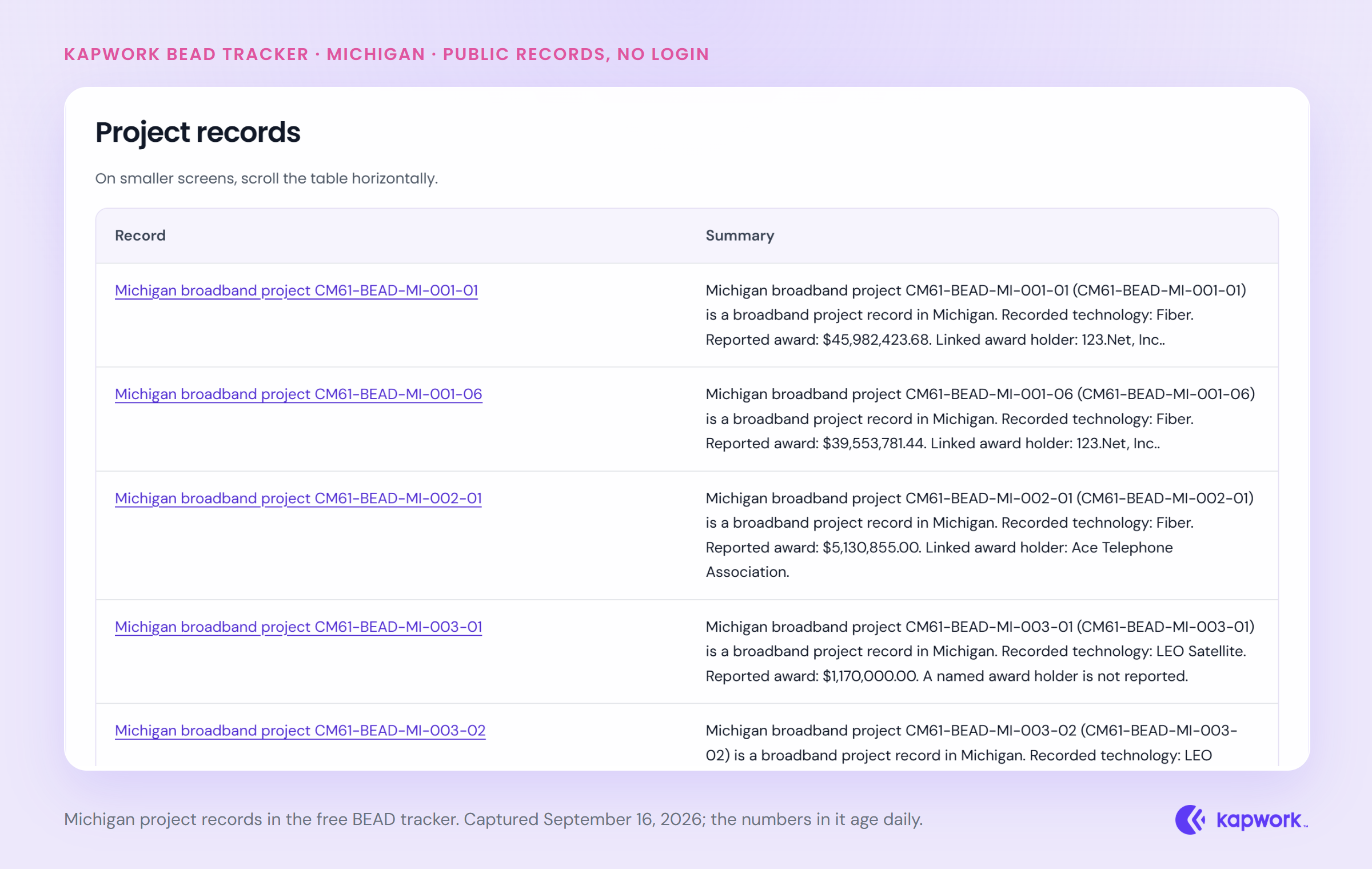
Where can I see who received BEAD awards in my state? In Kapwork's free BEAD tracker, which lists every reported award holder by state, with award status and each state's cash rules. Michigan is fully open, no login.
What is BEAD? The Broadband Equity, Access, and Deployment program: $42.45 billion in federal grants, run by NTIA, that states use to pay subgrantees to build high-speed internet where there is none.
About the author. Mauricio Vergara is co-founder and CEO of Kapwork. Before Kapwork he led teams at Google, where he watched third-party developers struggle with cash flow, and before that he ran a small business that waited months on its own invoices. Kapwork was founded with Pete Thomas, who helped build C2FO, the working capital platform with half a trillion dollars in receivables flowing through it.
About Kapwork. Kapwork is an AI-native platform helping small businesses find growth opportunities, certify receivables and get matched with capital providers. The company has certified half a billion-plus in receivables, most of that coming from telecom and data center providers. Backed by SaaSholic, Kapwork is also a member of NVIDIA's Inception, a program supporting innovative AI startups. Learn more at kapwork.com.
A note on how this was written: I used AI tools to research and draft parts of this piece. The numbers were checked by hand, and the argument is mine.