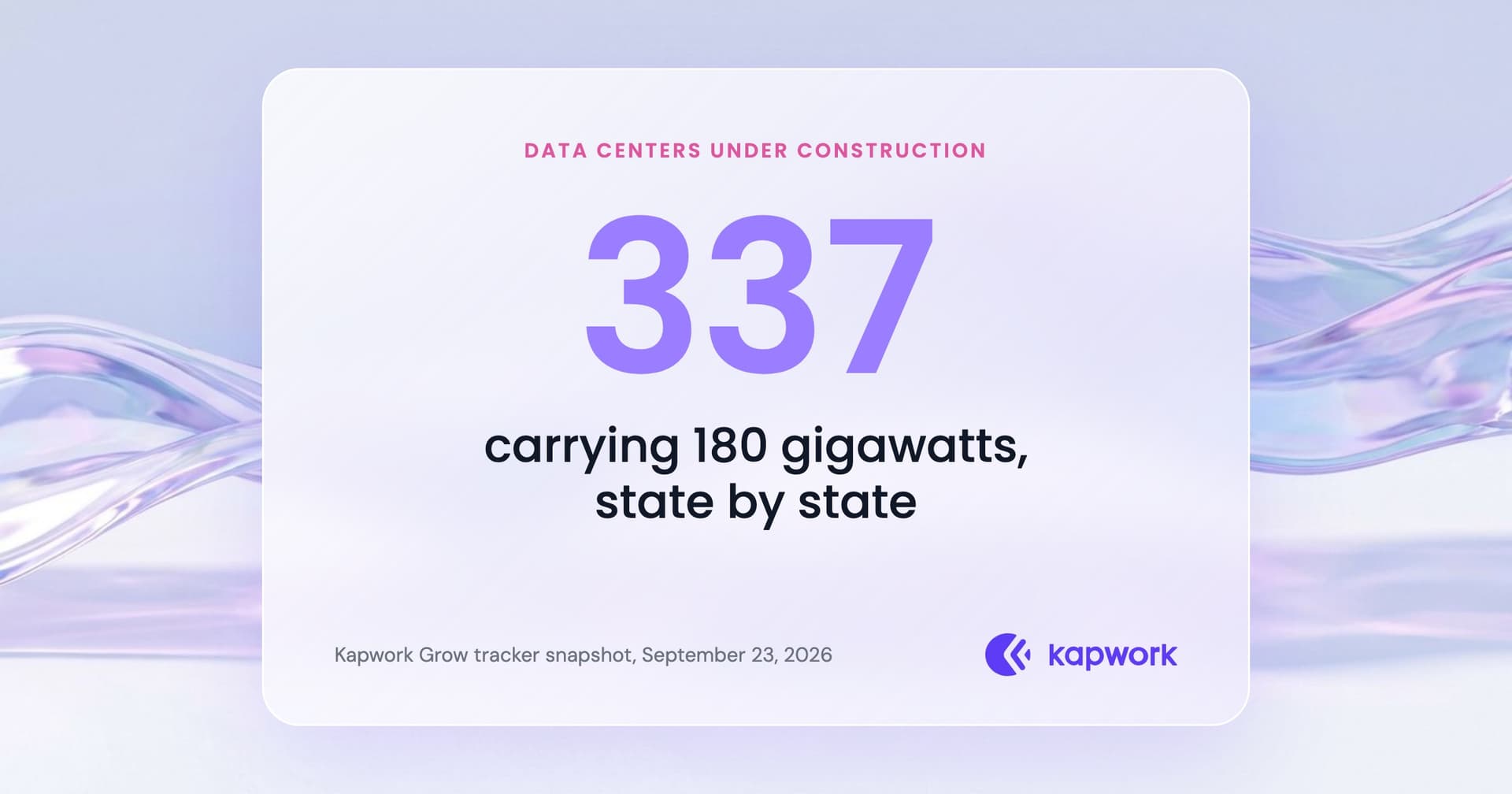
Kapwork Grow figures from the tracker snapshot of September 23, 2026.
In brief. US data center construction ran at more than $75 billion a year in July 2026, up nearly 60 percent from a year earlier, and that figure covers only the buildings. Every campus needs metro rings, long-haul routes and last-mile fiber, cabling inside the halls and wireless across the site. That work goes to telecom crews, and it bills to Lumen, Zayo, Dycom and hyperscaler network procurement on their terms, months after the crews roll. Kapwork Grow tracks 337 data centers under construction right now, carrying 180 gigawatts, plus 980 more proposed, approved or expanding, state by state, free. Free invoice certification lets a sub fund that work from the invoices it already sends.
The Census Bureau put private data center construction at an annual rate of more than $75 billion in July 2026. That is nearly 60 percent above July 2025 (Census data via Axios, September 1, 2026). The figure counts the shells: labor, materials, engineering and contractor profit on the buildings. The servers, chips, racks and fiber that go inside are not in it, and construction is only about 20 percent of what a data center costs, per a Cushman & Wakefield estimate cited in the same report.
Starts tell the same story from the front end. ConstructConnect counted $84.1 billion of US data center construction starts through July 2026, nearly three times the level a year earlier, across 136 projects. The average 2026 project with known figures costs $1.06 billion and covers 701,000 square feet (ConstructConnect, September 2026 Data Center Report).
For a telecom sub, each of those campuses is a fiber job, a cabling job and a wireless job before a single server turns on. Each of those jobs becomes an invoice, and each invoice pays on the customer's terms, weeks or months after the crews roll. This article covers where the builds are, what work they need, who pays for it, and how to have the funding lined up before the purchase order lands.
What telecom work a data center needs
A data center is a telecom job before it is a computing job. Nothing inside it works until fiber reaches the site from more than one direction, the halls are cabled, and the campus has wireless coverage for the people building and running it.

Fiber to the campus. Every new build needs metro rings, long-haul routes and last-mile fiber. A metro ring is the fiber loop a carrier builds around a city so that one cut doesn't drop traffic; a data center hangs off that ring, usually on two or more paths. Long-haul routes tie the campus to other regions, and last-mile fiber runs from the ring into the site. That is outside-plant work: boring and plowing conduit, aerial and underground placement, pulling and splicing fiber, testing, make-ready on poles, and restoration.
Inside the halls. Each hall needs structured cabling, fiber and copper, from the meet-me room to the racks, plus the cross-connects between carriers and tenants. That is inside-plant work, bought by the operator or through the prime on the job.
Across the site. A large campus needs DAS and small cells so crews and operations staff have coverage inside concrete buildings, and some sites run a private network of their own.
Who gets it. Fiber crews, structured cabling shops, DAS and small cell installers, and the trades under the electrical primes. The customers are the ones telecom subs already bill: Lumen, Zayo, Dycom and hyperscaler network procurement. Same customers, bigger invoices. If you build for carriers today, the fiber crews and tower crews pages cover how that work gets paid; this article covers where the next of it is coming from.
Who pays for data center telecom work, and when
Data center telecom work bills to the carriers building the routes, the primes they hire, and the operators' own procurement teams. On carrier work the names are Lumen, Zayo and Dycom. On a hyperscaler campus it is network procurement at the operator, paid through a vendor portal like Ariba, Coupa or the customer's own system, the same portals a telecom sub already logs into.
The terms are the ones you already carry. Verizon runs net-90, AT&T moved its NATE contractors to 30 days, and across construction subs wait an average of 51 days after submitting a pay application (Billd, 2026 National Subcontractor Market Report). Under a prime, a pay-when-paid clause passes the customer's clock down to you, and retainage of 5 to 10 percent holds until closeout.
That is the arithmetic the map doesn't show. The campus is announced, the ring gets extended, the crews roll, the invoice goes in, and the money lands weeks or months later. Mobilization, payroll and materials sit on the sub in between. Kapwork has certified more than $700 million in receivables, most of it from telecom and data center providers, so this gap is the one we see every day.
Which data center projects are real: announced vs. building
Announced and building are different numbers. ConstructConnect is tracking 85 data center projects worth $78.7 billion with start dates before the end of 2026, and its own report notes there is no guarantee any single one reaches groundbreaking (ConstructConnect, September 2026). Developers file power requests for sites they may never build, announce campuses to lock in land and tax terms, and shelve them quietly. A sub that mobilizes toward a press release can wait a long time for a purchase order.
Kapwork Grow builds its listings from seven public datasets, each licensed for commercial use with attribution: Compute Atlas, Server Country, Pennsylvania DEP, EPA ECHO, the Texas Comptroller, UVA DC-SENSE and the Public Evidence Project. Every page shows how many of them report the build and what each one says, so you can tell a project four sources agree on from one that a single dataset mentions. Of the 337 builds under construction, 100 are confirmed by two or more datasets.
Every facility has its own page, and every fact on it carries its source and an as-of date: the operator, the place, the size in megawatts, and the stage, from proposed through approved and under construction, plus expansions of operating campuses. When a source updates, the page updates and the date moves with it.
Two things the tracker can't tell you. Public records don't name the general contractor or the electrical prime the operator hired, so no public source has it. And a permit says a campus is real; it doesn't say when the fiber gets ordered. A listing is a research signal, not an open bid or a promise of subcontract work; confirm procurement with the operator before you mobilize.
Where data centers are being built, state by state
The builds are moving inland. Through July 2026, Indiana, Illinois, Michigan and North Carolina each recorded $10 billion or more in data center construction starts, Texas posted $9.9 billion, and Ohio, Wisconsin, Arkansas and Georgia each added several billion (ConstructConnect, September 2026). Of the projects scheduled to start before year-end, the South holds 71 percent of the value, anchored by Texas, Virginia, Arkansas and Georgia at more than $2.5 billion each. The Midwest holds 20.2 percent, mostly Ohio, and the West 8.7 percent, mostly Utah.
By count rather than dollars, Virginia, Texas and Georgia lead in planned data centers. Data Center Map listed 287 planned in Virginia, 170 in Texas and 141 in Georgia as of February 2026, with Illinois at 123 and Arizona at 86 (Pew Research Center). Counting methods differ, so those numbers won't match the map below.
Here is what Kapwork Grow shows today: reported capacity by state, across every build from proposed through expanding.

How to find data center projects in Kapwork Grow
Kapwork Grow is a free directory of BEAD awards and data center builds, and the public pages need no login. Here is how a sub uses it:
- Type a trade, a buyer or a place into the search box: "fiber ohio", an operator's name, or "Texas". BEAD awards and data center builds come back in one list.
- Read the result line: operator, place, size in megawatts, stage, and the date the record was last confirmed.
- Open the facility page. Every fact shows where it came from and when, so the page can go straight into a bid file.
- Filter by state to see everything in your territory, or jump from a state's BEAD page to that state's data center builds.
- Set a free alert for your state: one daily email when the records move, the same watch that already runs on BEAD awards.
Project databases like Dodge and ConstructConnect charge thousands of dollars a seat for construction intelligence. Kapwork Grow is free because Kapwork earns its fee from funders, when a business accepts a funding offer, and never from the business.

How to get on a data center vendor list before the RFP exists
The build listing is the earliest public signal you get. By the time an RFP for the fiber or the cabling exists, the vendor lists are set, and the crews on them were prequalified months earlier. Three things to do the week a campus shows up in your state:
- Find out who is building the network. The listing names the operator. The ring extension and the long-haul route are usually a carrier's job, often through a prime, and the inside cabling runs through the electrical prime or the operator's own procurement. Start with the one you already bill.
- Get your prequalification package current: insurance certificates, bonding capacity, safety record, references from carrier work, and the trade you are bidding.
- Line up funding before the purchase order lands. A new bank line takes 7 to 11 weeks to open. Certifying the carrier and operator invoices you already send takes one 20-minute setup, and the offers are on the table when the PO arrives.
What a certified invoice is
A certified invoice is one whose existence, amount, approval status and payment terms Kapwork has certified within your customer's own system of record, usually a vendor portal like Ariba or Coupa. It has nothing to do with certified payroll. You sign in to the portal yourself, inside Kapwork, connect it once, and the certificate keeps itself current from what the portal already shows. Funders in the Kapwork network then bid on it, and a certified invoice draws more offers and better rates than one a funder has to verify by phone. Kapwork sends no notice of assignment and never contacts your customer; some funders ask for one, and if an offer includes it you see that before you accept. The full mechanics, including why funders pay less for an invoice they can't verify, are in our BEAD article.
Where to start
Track data center builds and BEAD awards in your state at kapwork.com/grow, free. To certify the invoices you already send, start here. Or take 20 minutes with Kyle Mason, Kapwork's Head of Capital Markets. Funding questions, no pitch. Free for your business; the funder pays us, only when you accept an offer.
Data center construction questions
How many data centers are being built in the US? Kapwork Grow tracks 337 data centers under construction right now, carrying 180 gigawatts, plus 980 more proposed, approved or expanding. Census data put construction spending on data center buildings at more than $75 billion a year in July 2026. Counts vary by method: Data Center Map listed 287 planned data centers in Virginia alone in February 2026.
Which states have the most data center construction? By construction starts through July 2026, Indiana, Illinois, Michigan and North Carolina each passed $10 billion, with Texas at $9.9 billion (ConstructConnect). By planned count, Virginia, Texas and Georgia lead (Data Center Map, via Pew Research Center, February 2026). The map above shows what is on the public record in Kapwork Grow.
Who builds data centers? The owner is a hyperscaler, a colocation operator, or a developer building for one of them. A general contractor runs the site, the electrical and mechanical primes usually hold the largest packages, and telecom crews build the fiber, cabling and wireless. Public records don't name the GC or the primes, so Kapwork Grow shows the operator and the stage, not the contractor.

What fiber work does a data center need? Metro ring extensions, long-haul routes and last-mile fiber into the site, on diverse paths so a single cut doesn't take the campus down, plus structured cabling inside the halls. That is outside-plant and inside-plant work for fiber crews and cabling shops.
What is a data center fit-out? The interior build of a data hall after the shell is up: power distribution, cooling, racks, cabling and network gear. Telecom subs come in at the cabling and connectivity stage.
How do data center subcontractors get paid? On the customer's terms, through its vendor portal, after the invoice is approved: net-90 at Verizon, 30 days for AT&T's NATE contractors, and pay-when-paid under a prime. Across construction, subs wait an average of 51 days after a pay application (Billd, 2026).
What does it cost to build a data center? ConstructConnect's average for 2026 projects with known figures is $1.06 billion and 701,000 square feet, about $1,512 per square foot. Construction is roughly 20 percent of a data center's total cost; the rest is the equipment inside (Cushman & Wakefield estimate, via Axios).
Does Kapwork Grow list every data center? No. It lists the builds that seven licensed public datasets report, from proposed through under construction and expanding. Every fact carries its source and a date, and each page shows how many datasets report the build.
Is Kapwork Grow free? Yes. The public pages need no login, and a free account adds alerts for your state. Kapwork earns a fee from the funder when a business accepts a funding offer, never from the business.
What is a certified invoice? An invoice whose existence, amount, approval status and payment terms Kapwork has certified within your customer's own system of record. It has nothing to do with certified payroll, and it doesn't guarantee your customer will pay.
About the author. Mauricio Vergara is co-founder and CEO of Kapwork. Before Kapwork he led teams at Google, where he watched third-party developers struggle with cash flow, and before that he ran a small business that waited months on its own invoices. Kapwork was founded with Pete Thomas, who helped build C2FO, the working capital platform with half a trillion dollars in receivables flowing through it.
About Kapwork. Kapwork is an AI-native platform helping small businesses find growth opportunities, certify receivables and get matched with capital providers. The company has certified $700 million-plus in receivables, most of that coming from telecom and data center providers. Backed by SaaSholic, Kapwork is also a member of NVIDIA's Inception, a program supporting innovative AI startups. Learn more at kapwork.com.