
A fiber contractor with two carrier customers, $9M in receivables, and crews in four states closes a $20M asset-based revolver at a rate the CFO was happy with. But six months later that same CFO is doing Thursday-night math to see if Friday's payroll clears. Why?
The business is technically doing fine and the crews are billing, but the cash is now routing through a funder, and two documents that most teams skim at closing will decide when the company gets its cash back. The first one is the deposit account control agreement, or DACA, and the second one is the cash management section of the credit agreement.
This piece covers both documents. What a DACA actually is, how cash dominion works, where the liquidity leaks hide, and the ten terms I'd negotiate before any facility closes.
I started my career running a restaurant and a catering business, so I learned early that the number on the invoice and the number in the bank are two different things. Today I run Kapwork, which has certified more than $700 million in receivables, and a lot of my time goes to telecom subcontractors: tower erectors, fiber crews, broadband installers and other critical service providers. They do the work for carriers like Verizon and T-Mobile and equipment makers like Ericsson, then wait months to get paid. I spend my days between those businesses and the funders who lend against their receivables, and what follows is the briefing I wish every CFO received before signing a term sheet.
What a deposit account control agreement actually is
A DACA is a three-party contract between you, your funder, and the bank that holds your deposit account. It gives your funder "control" of that account in the legal sense.
Why it exists: under Article 9 of the Uniform Commercial Code, control is the only way a funder can perfect a security interest in a deposit account. A UCC-1 financing statement, which perfects liens on nearly everything else, doesn't work for bank accounts. So if your accounts sit at banks other than your funder, expect a DACA on each one that touches collateral proceeds. Your funder isn't being paranoid. Without it, another creditor could reach that cash first.
Two practical points follow.
- Your bank now takes instructions about your money from someone who isn't you, under conditions the DACA defines.
- DACAs take real time to negotiate, because the bank is taking on obligations to your funder. Start them early or they'll hold up your closing.
ABL is where you'll see this most, but factoring, invoice finance, and many private credit facilities run on the same rails. If you use any form of receivables finance, some version of this applies to you.
Springing vs. blocked: the two kinds of DACA
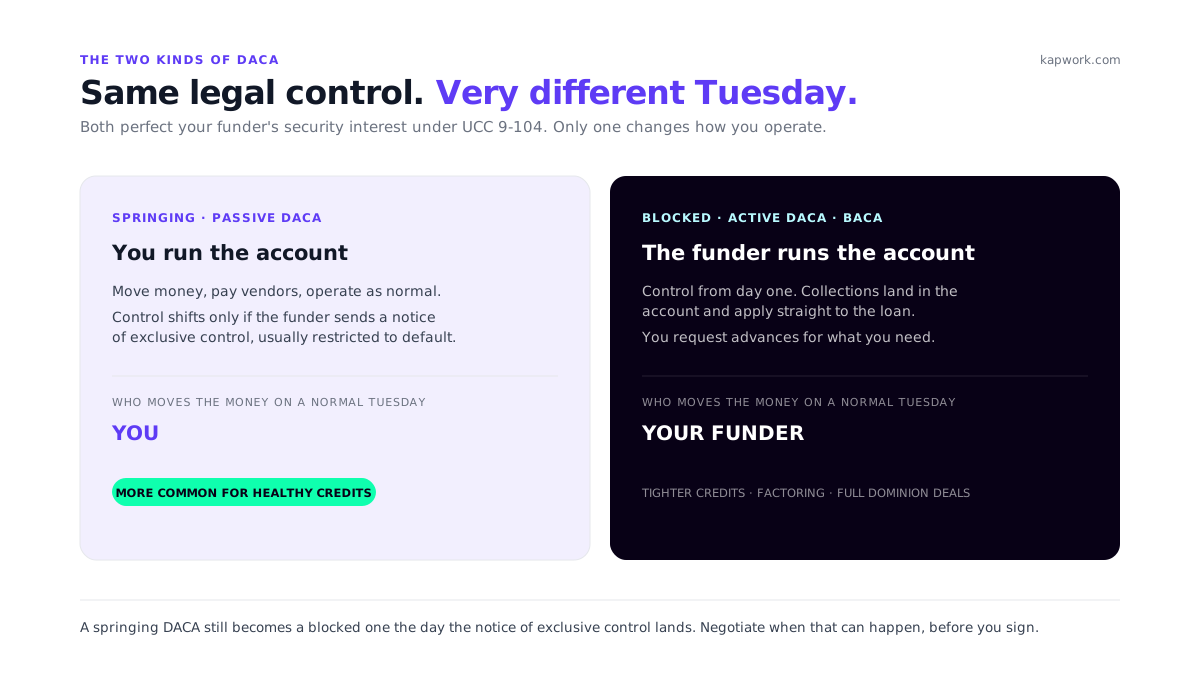
Every DACA falls into one of two buckets, and the difference decides your daily reality.
A springing DACA, also called a passive DACA, leaves you in control of the account day to day. You move money, pay vendors, run the business. The funder's control "springs" only when it delivers a notice of exclusive control to your bank. From that moment, the bank stops taking your instructions and takes the funder's. Most credit agreements restrict when the funder can send that notice, usually to an event of default or a defined trigger. This is the more common structure for healthy middle-market credits.
A blocked DACA, also called an active DACA or blocked account control agreement (BACA), gives the funder control from day one. You can't move funds out without the funder's consent. Collections land in the account and get applied to your loan. You'll see this on tighter credits, in factoring, and anywhere the funder wants full cash dominion from closing.
Both structures perfect the funder's interest. Only one changes how you operate daily.
Cash dominion: how the sweep actually works
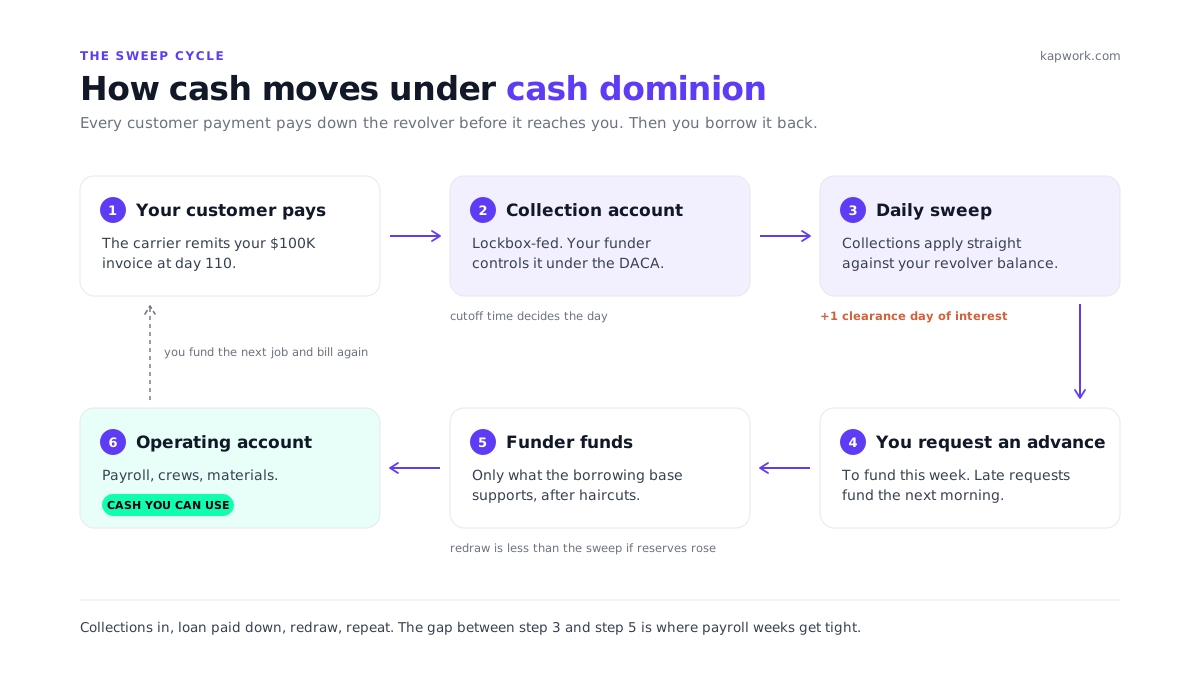
Cash dominion is the arrangement where your customers' payments pay your funder before they reach you.
Mechanically, a typical asset-based facility runs on two accounts. Customer payments flow into a collection account, often fed by a lockbox, that the funder controls. The funder sweeps that account, usually daily, and applies the cash against your revolver balance. You then request an advance to fund operations, and the funder funds whatever your borrowing base supports. Collections in, loan paid down, redraw, repeat.
Dominion comes in two kinds.
Full dominion runs from day one. Every collection sweeps from closing forward. Common in factoring, in stressed credits, merchant cash advances (MCAs), and with some non-bank funders.
Springing dominion sits dormant until a trigger fires. The market-standard trigger is excess availability falling below a negotiated threshold, typically somewhere between 10% and 25% of the line, often written as the greater of a percentage and a fixed dollar amount. An event of default is the other trigger. Until one of those happens, collections can flow into an account you control.
Real trigger language, from a recent credit agreement: dominion starts when availability falls below the greater of 15% of the line cap or $6.25M, and ends only after availability holds above that level for three consecutive business days. Other deals require 30 or even 60 consecutive days above the threshold to exit. Some go further: trip the trigger twice in twelve months and dominion becomes permanent.
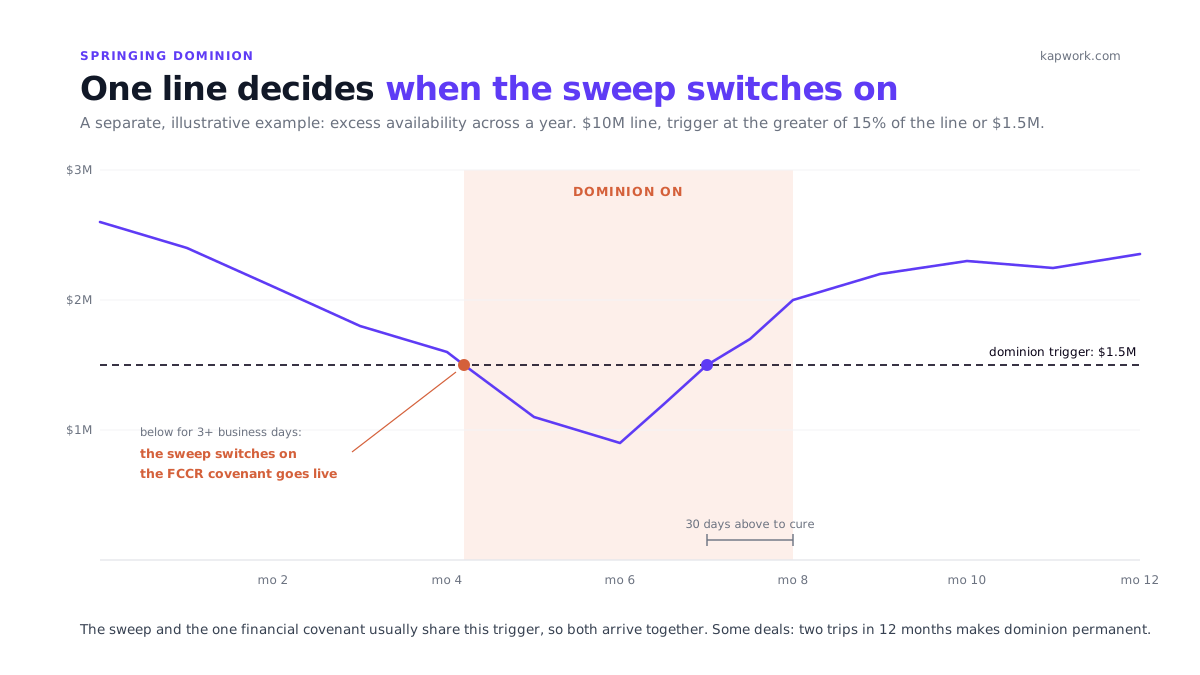
A cash flow funder and an ABL funder protect themselves differently. The cash flow funder watches you: a package of financial covenants tested every quarter. Leverage, coverage, minimum EBITDA. An asset-based funder protects itself by holding the cash instead. So many ABL facilities carry a single financial covenant, a fixed charge coverage ratio, which asks whether the cash your business generates covers your debt payments and other fixed charges. Even that one often sits dormant, tested only when availability falls below a threshold.
Fewer covenants in exchange for cash control is a reasonable trade. Just read the fine print on timing: the covenant test and the dominion sweep often share the same trigger. Fall below the threshold and both switch on together, the same day, at your tightest moment. That's the deal you're actually signing.
How do I calculate the liquidity impact?
A company can have a sizable line and strong receivables and still feel broke. Here's how.
Your borrowing base is a calculation you don't control: eligible receivables times an advance rate, minus reserves.
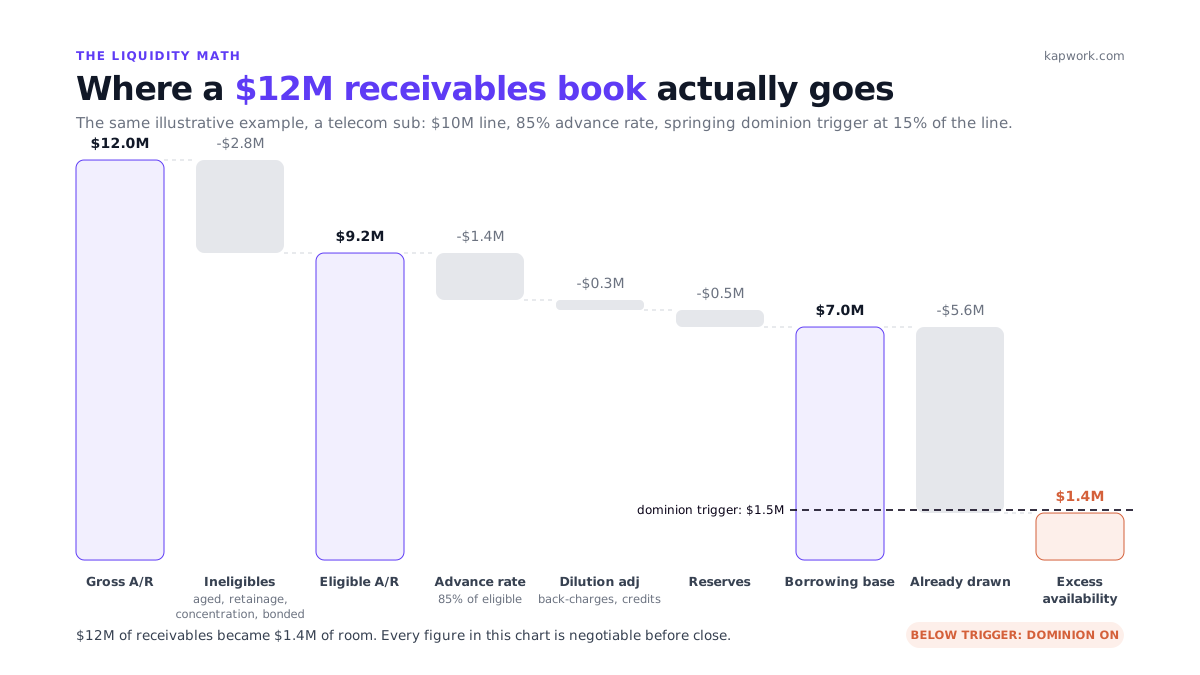
Ineligibles shrink the base. Standard exclusions include invoices past 90 days, amounts above concentration limits on a single customer, contra accounts where you both buy from and sell to the same party, foreign receivables, and government receivables that don't comply with the Assignment of Claims Act. Cross-aging is the sneaky one: if enough of a customer's balance goes past due, all of that customer's invoices can drop out. Your gross A/R will always be greater than your “lendable A/R”.
Dilution cuts the advance rate. Credits, returns, disputes, and chargebacks reduce what your receivables actually collect. It's common for agreements to trim the advance rate a point for every point trailing dilution runs above a set level, often around 5%. A heavy credit-memo quarter quietly costs you borrowing capacity.
Reserves come off the top. Funders can hold back availability for rent at locations without landlord waivers, for taxes, for anything their credit judgment flags. If the methodology isn't defined in your agreement, they can set whatever number they see fit.
Now stack all of that on top of dominion. Collections sweep daily against the revolver. To get cash back, you redraw against the base. If ineligibles rose and a new reserve appeared the same week, what you can redraw is less than what got swept. On Monday your carrier pays a $1M invoice: the sweep takes every dollar, the paid invoice drops out of your borrowing base, and at an 85% advance rate your room grows by only $150K. Add $800K of another carrier's paper aging past day 90 and a $150K back-charge reserve the same week, and you collected a million dollars in cash but can draw $680K less than you could Monday morning.
Timing adds friction. Watch for clearance or float days: many agreements charge one business day of interest on every collection, sometimes more, and some charge it even when your loan balance is zero. Cutoff times matter too. A payment that lands after the cutoff counts the next business day, and a redraw requested late funds the next morning. None of this shows up in the pricing grid. All of it shows up in a payroll week.
If you build for carriers and hyperscalers, read this twice
Everything above applies to any borrower. But if your customers are carriers, turf vendors, or data center GCs, your receivables have three features the standard definitions punish:
- Slow-paying investment-grade customers
- Heavy concentration
- Construction-style billing
Slow-paying investment-grade customers
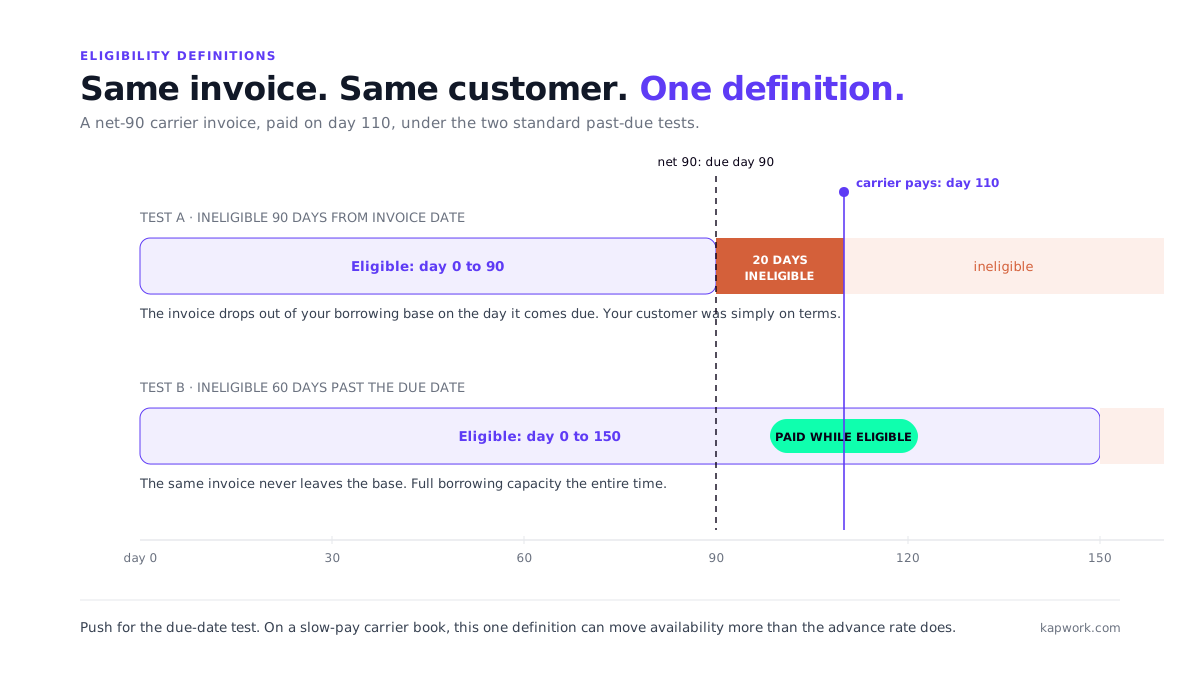
Your customers are strong credits that pay slowly. They'll all pay, but the standard eligibility test doesn't care about that. The common formulation makes an invoice ineligible at 90 days from invoice date, or 60 days past the due date, depending on which version your agreement uses. On net-90 terms, the invoice-date version kills an invoice the day it comes due. The due-date version keeps it alive until roughly day 150. Same invoice, same customer, wildly different borrowing base. Push for the due-date test and for extended eligibility on named slow payers. For a telecom sub, this is the single highest-value definition in the agreement.
Heavy concentration
Two customers at 40% each blows through a standard 15% or 20% concentration limit. But real credit agreements tier these caps: one recent deal ran 15% for ordinary customers, 25% for investment-grade ones, and 30% for named accounts. Others go to 50% or higher for a named customer while it holds an investment-grade rating. To be fair, a concentrated book carries real risk: setoff rights, back-charges, program cancellations. So don't expect the limits to go away. Expect them to be tiered, and ask for definitions that recognize what your paper actually is: strong credit with ugly aging.
Construction-style billing
Retainage is almost always ineligible, and where it is, it's advanced at low rates with hard caps. Unbilled work and progress billings usually sit outside the base too, though some facilities define eligible unbilled accounts at a lower advance rate, worth asking for if your billing lags the work. And receivables on bonded jobs are typically excluded, because the surety's rights can prime the funder's lien. If you're bidding bonded broadband or municipal work, know how much of your book those three remove before you size the line.
Concentration also changes how dominion behaves. With two or three payers, one carrier slipping 30 days doesn't erode your availability. It steps it down, all at once, which is exactly how springing triggers get hit. For this book, the multi-day trigger test and the due-date aging fix are essential.
What a DACA does to your balance sheet
Under ASC 470-10, borrowings under a revolver that requires a traditional lockbox arrangement and contains a subjective acceleration clause are classified as a current liability. A "material adverse change" clause counts as a subjective acceleration clause. The maturity date on the credit agreement doesn't matter. Because collections automatically pay down the debt and the funder can accelerate on judgment, GAAP treats the whole balance as short-term.
A springing lockbox that hasn't been triggered is different. Collections don't automatically reduce the debt, so those borrowings can stay noncurrent.
Why you should care: current classification hits working capital metrics, ratios in your other agreements, and the picture your board and your customers' credit teams see. If you carry bonding, it bites twice. Sureties underwrite your working capital, so a revolver reclassified as current can shrink your bonding capacity right when you're bidding bonded broadband work. If long-term classification matters to you, the springing structure is a reporting decision as much as an operational one. Get your auditor's read on the credit agreement before you sign it, not at year-end.
Ten terms to negotiate before the loan closes
Most teams negotiate the line size, the advance rate, and the spread, then treat the cash management exhibit as boilerplate. The leverage runs the other way. Here's what I'd push on, in order.
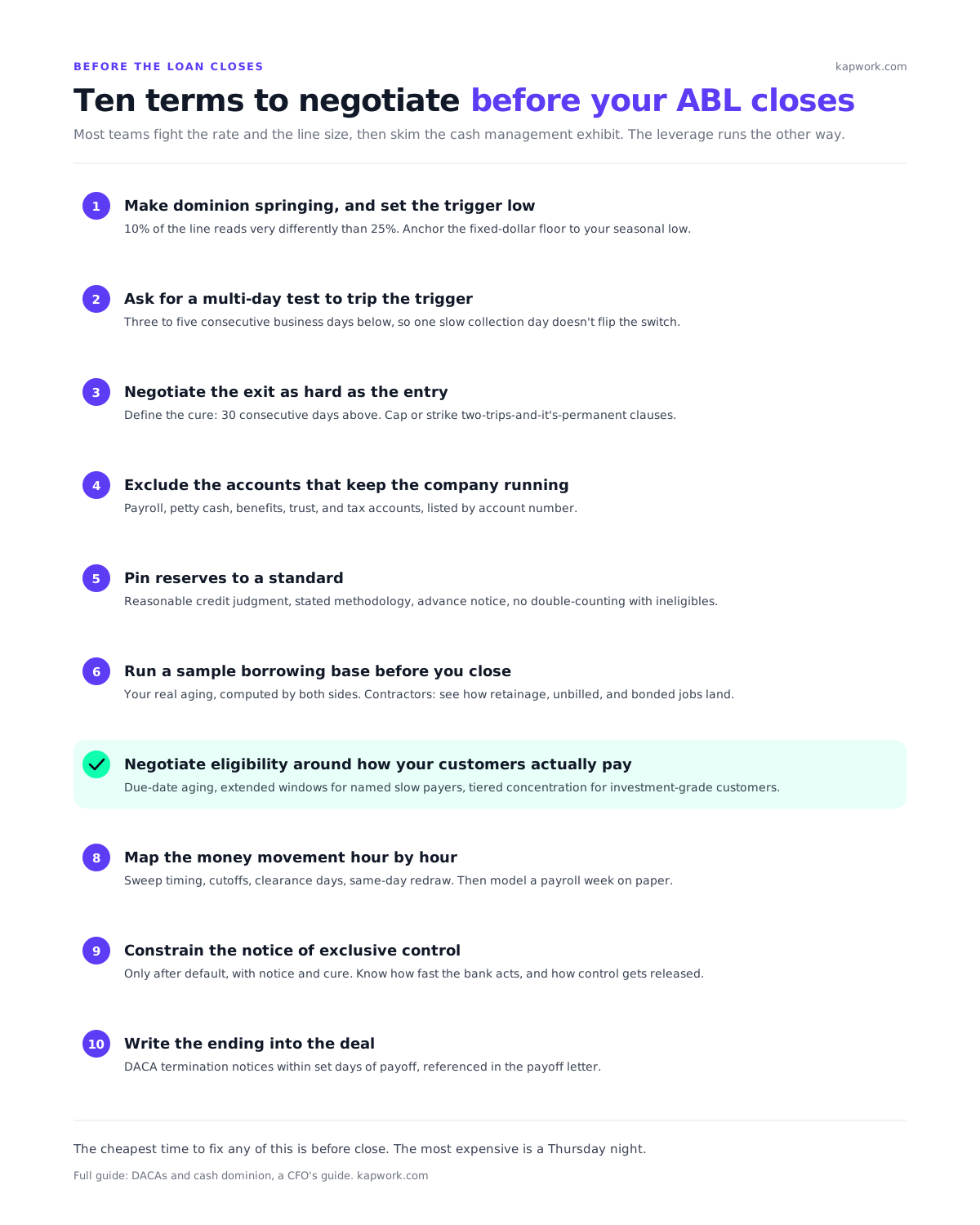
Make dominion springing, and set the trigger low. If the term sheet says full dominion, ask what it takes to make it springing. Then fight the threshold: 10% of the line reads very differently than 25%. Anchor the fixed-dollar floor to your seasonal low point, not the funder's template.
Ask for a multi-day test to trip the trigger. Availability below the threshold for three to five consecutive business days should start dominion, so a single slow collection day doesn't flip the switch. Funders won't always give it, but it's a known ask.
Negotiate the exit as hard as the entry. Availability back above the threshold for 30 consecutive days is common, and even 60 shows up. Cap or strike any clause that makes dominion permanent after two trips in twelve months.
Exclude the accounts that keep the company running. Payroll, petty cash, employee benefit, trust, and tax accounts are customary carve-outs from control agreements. List them by account number so there's no debate later.
Pin reserves to a standard. Push for a defined "reasonable credit judgment" standard, a stated methodology, advance notice before new reserves take effect, and language preventing the same risk from being counted as both an ineligible and a reserve.
Run a sample borrowing base before you close. Hand the funder your actual aging and have both sides compute availability from it. You'll learn your real concentration exposure, your cross-aging risk, and your trailing dilution while you still have negotiating power. If you're a contractor, make the sample show exactly how retainage, unbilled work, and bonded jobs are treated. Those three can be the difference between the line you think you bought and the one you got.
Negotiate eligibility around how your customers actually pay. If your customers run net 60 to net 120, push for the past-due test measured from the due date, plus extended eligibility windows for named slow payers. Then ask for tiered concentration limits: higher caps for investment-grade customers, and a named-customer cap for your biggest account. For a slow-pay book, these two definitions can move availability more than the advance rate does.
Map the money movement hour by hour. Sweep frequency, bank cutoff times, clearance days charged, and same-day redraw mechanics. Then model a payroll week on paper. If the model is tight, fix the mechanics now, in the documents.
Constrain the notice of exclusive control. The credit agreement should say exactly when the funder may send one, ideally only after an event of default with notice and cure. Ask your bank how fast it acts on the notice, and how control gets released when the trigger clears.
Write the ending into the deal. Require the funder to deliver DACA termination notices within a set number of days after payoff, and reference that obligation in the payoff letter. A forgotten control agreement on an old account can stall your next financing.
Download: the ten-term DACA checklist (PDF)
Quick answers
Is a DACA the same as a lockbox? No, though people use the words loosely. A lockbox is a collection mechanism: customers remit to an address or account the bank processes. A DACA is the legal contract that gives your funder control of a deposit account. Most asset-based deals use both together.
Does every bank account need a DACA? Your funder will want control over accounts that receive collateral proceeds, especially accounts held at other banks. Payroll, benefits, trust, and tax accounts are customarily excluded. Negotiate the list before closing.
Can my funder freeze my account without warning? Under a blocked DACA it already controls the account. Under a springing DACA it must first deliver a notice of exclusive control, and your credit agreement should limit when it can. Banks act on a valid notice quickly, which is exactly why the conditions belong in writing.
When does cash dominion end? When the cure conditions are met, typically availability above the trigger for a defined consecutive period, or at payoff, once the funder terminates the DACA in writing. Watch for provisions that make dominion permanent after repeat triggers.
Why does my five-year revolver show as a current liability? Probably ASC 470-10. A traditional lockbox plus a subjective acceleration clause forces current classification regardless of the maturity date. A springing lockbox that hasn't triggered can stay long-term.
My customers pay in 90 to 120 days. Are those invoices automatically ineligible? Under the common test, an invoice goes ineligible at 90 days from invoice date or 60 days past due. On long terms, the invoice-date version can disqualify paper from customers who always pay, just slowly. Negotiate the due-date version and extended windows for named customers.
Is retainage part of my borrowing base? Usually not. Retainage is typically excluded as ineligible, and where funders include it at all, they advance at low rates with hard caps. Plan your liquidity as if retainage funds at zero, and treat anything better as negotiated upside.
What to take from this
Cash dominion is often the reason an asset-based funder can advance more, with fewer covenants, than a cash flow funder will. What hurts companies is signing it without running the math on how cash actually moves once the facility is live. The cheapest time to fix any of this is before close.
And underneath every term in this article sits one thing: trust in your receivables data. Ineligibles, dilution reserves, dominion triggers, field exams. They all exist because a funder can't independently confirm that the collateral is what you say it is. That uncertainty gets priced, and you're the one paying for it.
That's frankly why we built Kapwork. When your invoices are certified in your customer's own system of record, the data a funder prices is no longer your word alone. Certification doesn't rewrite a credit agreement. It changes what the person across the table can trust, and trust is what every one of these provisions is really pricing.
If you're heading into an ABL or receivables finance negotiation and want a second set of eyes on the cash management terms, happy to compare notes. Find me on LinkedIn.